Glassity Blog
FinOps 5 Steps Framework
A practical framework for implementing FinOps at the Run phase, from opportunity discovery through execution to feedback loops and celebration.
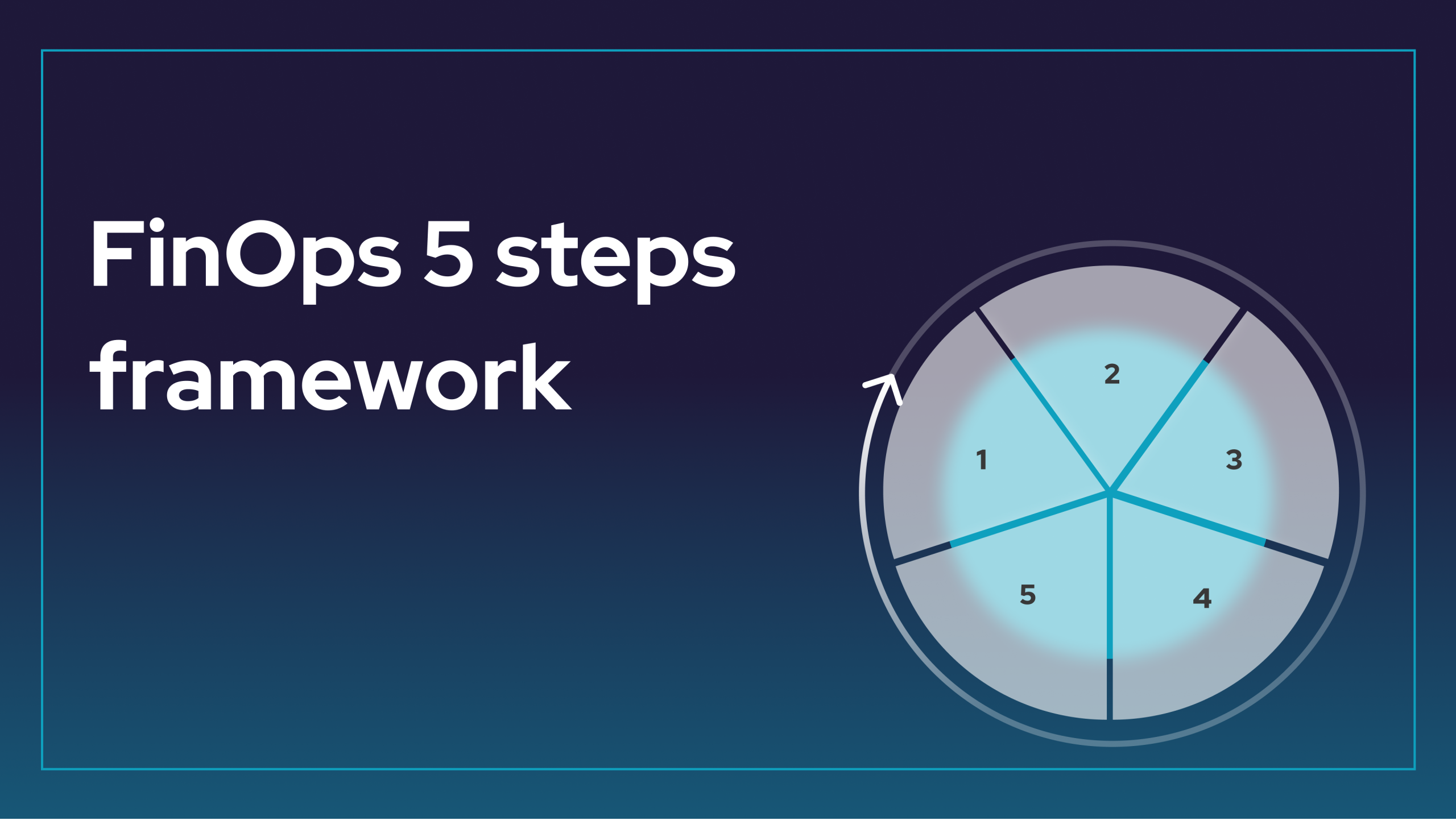
Cloud environments tend toward entropy. Left unmanaged, costs decouple from value: resources accumulate, commitments drift from actual usage, and waste compounds silently across accounts. The FinOps 5 Steps Framework addresses this directly. It is a structured, repeatable cycle built for the "Run" phase of FinOps maturity, where organizations move beyond basic visibility into continuous, automated optimization.
This framework is built for the era of AI agents, automated governance, and deep engineering workflow integration. It assumes that optimization is not a quarterly project but a continuous operational discipline, one that requires systematic discovery, rigorous evaluation, clear ownership, automated execution, and honest feedback loops.
Effective discovery draws from three channels:
-
Automatic discovery
Continuous scanning of cloud environments to identify waste, misconfigurations, underutilized resources, and suboptimal commitment coverage. This is the baseline. It runs without human intervention and surfaces most opportunities by volume.
-
Reactive opportunities
Insights that emerge from real usage patterns, incident responses, and day-to-day operations. An engineer notices that a staging environment runs 24/7 but is only used during business hours. A support ticket reveals that a database was provisioned at 4x the required capacity during an emergency and never scaled back down. These are optimization opportunities that automated scanning alone may miss.
-
Proactive ideas
Forward-looking initiatives like implementing guardrails to prevent waste before it happens, adopting new instance families with better price-performance, or restructuring workloads to take advantage of Spot pricing. These require human judgment and strategic thinking.
Discovery produces a pipeline of opportunities with enough context to evaluate each one. Visibility is the immediate benefit: teams see the full landscape of potential savings rather than working from isolated, ad-hoc observations. A strong pipeline is the prerequisite for everything that follows.
The core evaluation tool is a Risk, Effort, Value matrix. Each opportunity is scored across three dimensions:
-
Risk
What could go wrong? Does this change affect production workloads? Is it reversible? What is the blast radius if the estimate is wrong?
-
Effort
How much engineering time does implementation require? Does it need cross-team coordination? Does it involve infrastructure changes or just configuration updates?
-
Value
What are the projected monthly savings? How confident is the estimate? Is this a one-time fix or a recurring optimization?
Assessment must also account for opportunity cost. Engineering time spent on cost optimization is time not spent on features, reliability, or technical debt. A $500/month saving that requires 40 hours of work has a very different ROI than a $500/month saving that requires a single configuration change. Each assessed insight should carry full context: what is wrong, what it costs, how to fix it, and what happens if you do nothing.
Alignment involves three activities:
-
Automated ownership assignment
Every optimization opportunity is mapped to the team or individual responsible for the affected infrastructure. This happens automatically based on resource tags, account ownership, or organizational mappings. When ownership is explicit, there is no ambiguity about who acts.
-
Clear remediation plans
Each opportunity includes a concrete plan with specific steps, not abstract recommendations. Instead of"rightsize this instance," the plan says"change instance type from m5.2xlarge to m5.xlarge in the production Terraform module, estimated savings $340/month, no expected performance impact based on 90-day utilization data." Concrete steps remove uncertainty.
-
Stakeholder review
Engineering leads, finance, and platform teams review prioritized recommendations together. Assumptions are validated, concerns are surfaced, and execution is approved with shared context. This prevents the adversarial dynamic where finance pushes for cuts and engineering pushes back.
The goal is to remove every source of uncertainty before execution begins. When the groundwork is solid, execution becomes straightforward and low-risk.
The 5 Steps Framework shifts execution from human-gated remediation to automated, Shift-Left governance. Because the previous three steps established clear opportunities, validated assessments, explicit ownership, and concrete plans, execution becomes the natural next step rather than an uphill battle.
In practice, execution often takes the form of pull requests. The optimization is expressed as an infrastructure-as-code change (a Terraform modification, a Kubernetes manifest update, a configuration adjustment) delivered directly into the engineering team’s existing workflow. The pull request includes full context: what is changing, why, the estimated savings, and the risk assessment.
Engineers review and merge the change through their normal process. Code reviewed and merged equals optimization complete. There is no context switching, no manual translation from recommendation to implementation, and no parallel workflow to manage. The optimization goes through the same code review, approval, and deployment pipeline as every other infrastructure change.
Up to 50% on EC2, 69% on RDS.
Feedback has several components:
-
ROI reporting
Every executed optimization is tracked against its projected savings. Did the rightsizing action deliver the estimated $340/month? Did the Savings Plan purchase cover the expected usage? Report generation with verified ROI numbers builds organizational confidence in the process.
-
Lessons learned
What worked? What were the blockers? What enablers made execution faster? This analysis feeds directly back into Discovery, improving the quality of future opportunities and the accuracy of future assessments.
-
Recognition and celebration
Teams and individuals who drive optimization outcomes are recognized through leaderboards, CSR (Corporate Social Responsibility) impact metrics tied to reduced cloud energy consumption, and direct acknowledgment. Recognition reinforces the behavior you want to see repeated.
The feedback loop is what makes the framework a cycle rather than a checklist. Lessons feed back into Discovery. Assessment models are refined based on actual outcomes. Alignment processes improve as stakeholders develop trust in the accuracy of recommendations. Each iteration compounds on the last.
Glassity automates AWS cost optimization, delivering up to 50% savings on EC2 and 69% on RDS. You pay only 10% of what we save you. Book a free savings assessment.